
Curriculum Offer through Project Based Learning and Senory Diet
Intent
At Ladybird Manor School, we believe that every pupil is capable of progress and growth, regardless of their starting point. We are a nurturing, specialist setting that supports students with Autism Spectrum Disorder (ASD), Global Developmental Delay (GDD), specific learning difficulties, and broader neurodiverse needs.
Our curriculum intent is to:
– Deliver a bespoke and highly differentiated version of the National Curriculum, designed to be developmentally appropriate, functional, and flexible.
– Support the acquisition of key academic, communication, social, emotional and life skills through a highly structured, safe and sensory-aware environment.
– Offer project-based learning that provides real-world, hands-on experiences and cross-curricular connections that help pupils make meaningful links between subjects and life.
– Embed therapeutic and sensory approaches within the learning day to enable regulation and engagement.
– Prioritise communication (verbal, AAC, signing, PECs) and emotional regulation as foundational skills.
– Prepare students for the next stage of life by teaching them how to function more independently in their homes, communities, and (where appropriate) workplaces.
Our curriculum is ambitious for all learners and reflects the statutory expectations of EHCPs, tailored closely to individual needs. It celebrates neurodiversity, values small steps of progress, and enables each learner to develop a sense of identity, confidence and self-worth.
Implementation
The curriculum is implemented through a carefully sequenced, highly personalised and therapeutically-informed model, underpinned by consistent routines, strong relationships and a multi-disciplinary team approach.
Key Features:
– Curriculum Pathways: Learners are placed on appropriate pathways (e.g., pre-formal, semi-formal, formal) based on cognitive and developmental level. These pathways align with frameworks such as the Engagement Model, Routes for Learning, and MAPP.
– High staff-to-student ratios allow for intensive support, enabling pupils to access learning at their own pace with reduced anxiety and increased success.
– Project-Based Learning brings academic learning to life through cross-curricular themes (e.g., ‘Growing & Changing’, ‘My Community’, ‘The World Around Me’).
– Therapies and Interventions are embedded into daily practice: sensory diets, SALT, OT, emotional literacy tools.
– Structured teaching approaches include TEACCH, SCERTS, Attention Autism, PECS, Makaton.
– Outdoor and community learning includes farm visits, forest school, and local community access.
– Functional communication, social interaction, and independent living skills are rehearsed daily.
Assessment & Progress:
– Engagement Model: For pupils not engaged in subject-specific learning.
– Routes for Learning: For learners with profound and complex needs.
– MAPP: For assessing personalised, small-step progress.
– Evidence for Learning: For capturing and evidencing learning and progress through photos and qualitative data.
Impact
We measure the impact of our curriculum by looking at the whole-child development across academic, functional, emotional, and social domains.
Our curriculum has impact when:
1. Progress toward EHCP outcomes is visible and regularly reviewed.
2. Academic and functional attainment is improved through tailored teaching and support.
3. Personal development and wellbeing are enhanced, including emotional regulation and independence.
4. Engagement in learning is increased with improved task participation and reduced behaviour incidents.
5. Preparation for adulthood is evident in life skills, confidence, and readiness for transition.
6. Parental feedback and pupil voice confirm visible progress and satisfaction with provision.
At Ladybird Manor School, the curriculum is a living, breathing framework that adapts to each child’s needs. It enables engagement, safety, joy in learning, and above all, the belief that every pupil has the right to succeed and feel proud of their progress.
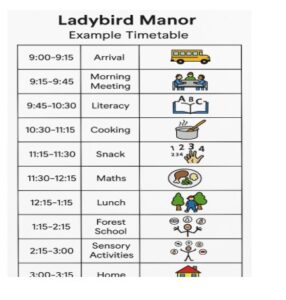
Example Timetable with Ladybird Manor
Implementation
Templecroft School provides a curriculum that is planned and delivered in a personalised and differentiated approach. We recognise that children learn in separate ways, so we provide visual, kinaesthetic, and auditory (where appropriate) resources.
Pupils are taught by Qualified Teachers in small class groups supported by specialist Teaching Assistants. The prominent level of staffing allows for individual and small group work as needed and the pace and style of teaching is modified to ensure all children can access lessons and make good progress. All staff have specialist qualifications ensuring an excellent quality of support for children’s individual learning needs.
PSHE/RHE is an important area of our curriculum and helps prepare our children for future independence, citizenship, healthy lifestyles, and personal safety. This includes an adapted PSHE curriculum that includes relevant research. PSHE runs throughout our school daily through PSHE lessons and activities, forest school, enrichment activities, and focused assembly time linked to our school values.
Our pupils need access to wider experiences to consolidate their learning and provide purposeful learning. As a school, we provide a wide range of educational visits and a variety of sporting events, including attending competitions with other local schools.
Impact
Pupils at Templecroft School make excellent progress. As a team, we constantly assess our pupils learning and progress. We use a range of assessment tools to monitor whether our curriculum is having an impact on teaching and learning. All teachers follow clearly adapted long term plans and medium-term plans for each subject.
Teachers are highly skilled and able to adapt to the needs of each individual pupil. As a school, we use teacher assessments to collate progress and assessment data. This is collected six times a year and then used to provide pupil progress meetings to discuss pupils’ achievements and identify any barriers to learning that may need extra intervention.
School council meet regularly and discuss how to improve the school and whether the curriculum is engaging and inspiring! All pupil feedback is shared and discussed in pastoral meetings with the pastoral team.
Baseline assessments are used when pupils start of their educational journey – This measures pupils’ knowledge, understanding and skills.